Labor forecasting software powered by analytics
Labor forecasting helps organizations predict labor demand and determine the optimal staffing levels needed to meet business goals while controlling labor costs.

Right person, right place, right time
Labor forecasting helps enterprises predict labor needs using historical workforce data, trends, labor standards and predictive intelligence to help your organization make data-driven workforce decisions.
Maximize performance using informed labor forecasts
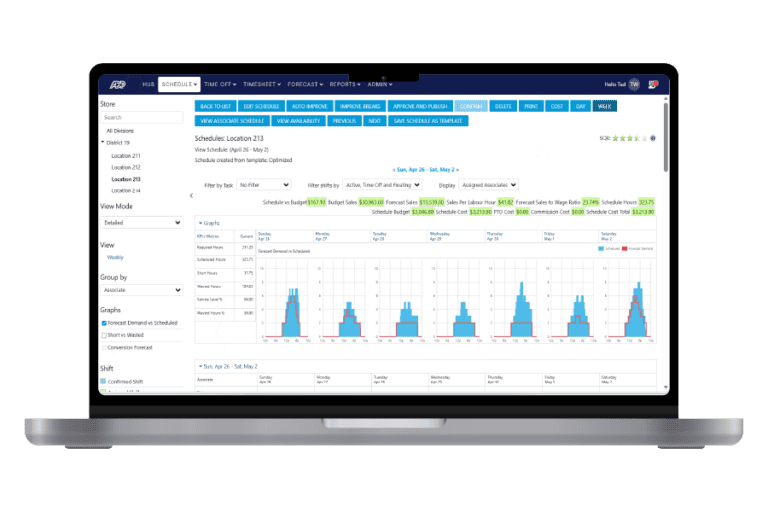
Predict demand down to 15-minute intervals to support business targets. Avoid the cost of overstaffing and unplanned idle time.
Create positive employee experiences
Enable fair and predictable schedules for more flexible worker experience. Reduce burnout and higher turnover rates due to understaffing.
Meet and exceed client expectations
Measure labor forecasts against key performance indicators for improvement. Account for foot traffic, transactions, call volumes, work orders and more.
Leverage data to refine your business performance
Proactively incorporate historical business data, emerging trends and predictive intelligence. Segment data to fine-tune forecasts by department, area or product line.
Prevent mistakes, diminished productivity, unplanned overtime and missed opportunities due to understaffing.
Align business volumes with staffing levels
Define labor standards for each group and activity. Set minimum and maximum staffing levels for each activity within a group. Incorporate time standards and time-and-motion data for more precise labor forecasts.
Account for foot traffic, transactions, call volumes, work orders, items to be produced and more.

Stay on track, even when isolated situations occur
Predict labor demand down to 15-minute intervals to support your business targets. Identify periods when labor demand may be higher due to seasonal or temporary variations.
Adjust for sales and other promotions, including slower periods before and after the event. Account for external influences on customer demand like adverse weather or road closures.
Let’s solve your unique challenges
Explore how labor forecasting and proactive data insights can help your operations stay on track with changing demand.

Optimize the performance of your workforce
ADP WorkForce Suite is designed to provide action-oriented analytics to help you get more done. Boost workforce productivity and operational efficiency in these key areas.



Frequently asked questions about ADP WorkForce Suite
How can a labor forecasting solution help predict the optimal labor required to meet your demand?
Labor forecasting software uses predictive analytics and AI-driven insights to forecast workforce demand, optimize staffing levels and improve labor planning. By analyzing historical business data, labor standards and emerging trends, organizations can anticipate future labor requirements and adapt to changing conditions such as seasonality, market fluctuations, weather events and shifts in client demand. Continuous comparison of forecasted and actual performance helps refine workforce plans over time, enabling more accurate scheduling, better labor cost control and informed business decisions.
What's the difference between labor forecasting and labor scheduling?
Labor forecasting and labor scheduling serve different purposes within enterprise workforce management. Labor forecasting focuses on predicting future labor demand based on workforce data, business trends and expected workload. Labor scheduling uses those forecasts to create schedules for workers that align staffing levels with anticipated demand. Labor forecasting is feature of our scheduling software solution that allows organizations improve shift planning and operational efficiency.
Why choose ADP WorkForce Suite for enterprise workforce management?
ADP WorkForce Suite is built for global organizations that need deep configurability, multi-country compliance and a platform that scales with complex operations. With prebuilt templates for 35+ countries, the ability to support operations in more than 100 nations, flexible integration with leading HCM and ERP systems and multiple implementation options, including ADP’s in-house unparalleled delivery, ADP WorkForce Suite gives enterprises the confidence, automation and agility they need to manage today’s workforce complexity.
Can ADP WorkForce Suite integrate with existing HCM or ERP systems?
Yes. ADP WorkForce Suite offers open REST APIs and prebuilt connectors for leading platforms such as SAP, Workday and Oracle. It’s designed to fit effortlessly within your broader digital ecosystem, so you can keep the systems you trust while connecting time, pay and labor data across your enterprise.
What implementation options are available?
Enterprises can choose between two proven delivery models:
ADP-led implementation, where ADP’s in-house experts provide an unparalleled experience with a single point of accountability; or
Certified SI implementation for organizations that prefer to use their existing SI relationships.
Both options follow the same proven method for speed, precision and measurable results.
What kind of support does ADP provide after go-live?
Every ADP WorkForce Suite client receives dedicated success resources focused on value realization, continuous optimization and compliance assurance. ADP’s service teams provide ongoing access to workforce experts, client community insights and around-the-clock or regionally extended support, all backed by more than 75 years of global payroll and workforce management leadership.